A Rainy Hour Among City Trees
A rainy hour among city trees can reveal how Seattle parks channel water, shelter wildlife and shape daily routes, while helping you choose a safer path.
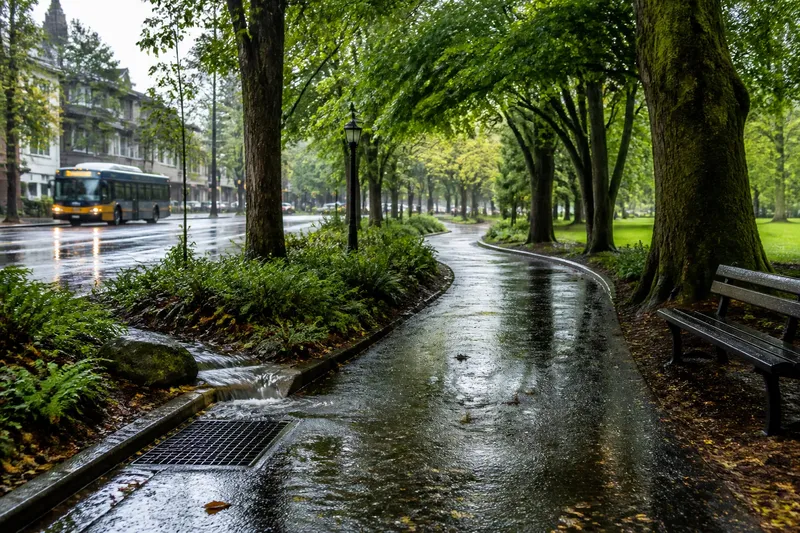
At a Seattle park entrance, rain gathers in the grooves of a path while a bus sighs past on the street. A rainy hour among city trees can show how the park moves water, where its paths stay passable and how its green edges meet the neighbourhood.
Read the park’s drainage
Rather than treating rain as scenery, follow its route from the pavement into the park. Water may run along a kerb, collect at a low point or disappear into a planted strip. From a firm path, notice where the ground sheds water and where it seems to take it in.
Seattle parks often sit beside streets, homes and other paved surfaces, so their edges can reveal how urban runoff meets soil and vegetation. Look for grates, shallow channels and planted swales, but do not step into standing water or assume a drain is clear. A clogged grate, a flooded path or a notice about closure is a reason to change your route or leave.
These observations can be useful on an ordinary dry-day walk, too. If water repeatedly gathers at one path edge, that spot may remain muddy after the rain stops; if the path slopes towards a drain, the surface may clear more readily. Treat this as a clue about where to walk, not a promise about conditions on another day.
Compare street and canopy
Stand where you can see both the tree canopy and a nearby street. Beneath dense branches, rain may arrive as scattered drips; beyond the canopy, it can fall more directly on paving. The contrast helps explain why a park path can feel different from the exposed pavement just outside its gate.
Notice how trees shape the boundary between park and city. A row of trunks may soften the view of parked cars, while gaps in the branches reveal rooftops or traffic. Rain also makes the boundary audible: traffic hisses on wet roads, then fades behind leaves and open lawn.
Keep to paths and avoid trampling planting beds to get a better view. If a branch hangs low or a tree appears damaged, give it space, particularly in wind. A park’s canopy is something to observe from a sensible distance, not a reason to leave a clear route.
Choose a route by surface
Rain changes how familiar routes feel. Smooth paving can become slick beneath fallen leaves; compacted gravel may offer firmer footing, while soil paths can turn soft or rutted. Check the surface ahead and choose the route that looks most manageable for your footwear and mobility.
- Check for standing water across the path; if it blocks a clear view of the surface, take another route or turn back.
- Check whether leaves cover smooth paving; if the path looks slippery, slow down and use a clearer, less steep alternative.
- Check for exposed roots or washed-out edges; if footing looks uncertain, keep to a wider paved route.
- Check signs and barriers at entrances; if a path is closed, follow the posted direction rather than going around the barrier.
- Check whether a bench or shelter is occupied or blocks movement; if it does, pause elsewhere without narrowing the shared path.
- Check your clothing and footing as you go; if you become cold, wet through or unsteady, head towards the nearest familiar exit.
Say you enter an invented neighbourhood park beside a busy road, with a paved main path and a narrow soil trail. You see water across part of the soil trail, leaves covering a sloped section of paving and a clear, level stretch leading back to the entrance. You choose the level paving, skip the flooded trail and return by the same route; the observable result is a walk that avoids the uncertain ground and keeps the exit in view.
Rainy hour among city trees
Rain makes leaves and bark look different, but the more revealing comparison is often between exposed and sheltered places. Watch how drops gather at the end of a branch, run down a trunk or fall from a canopy onto the path. Look without touching plants or moving into planted areas.
Sound can help you locate changes in cover. Rain on a broad leaf makes a different note from rain on pavement, and a gap in the canopy may send a brief stream of drips onto one patch of path. Pause somewhere wide enough for others to pass, and notice whether the sound shifts as wind moves the branches.
A phone note can preserve a useful detail for another visit: “water pools beside the western gate” or “the path under the large trees stays quieter than the street.” Keep it brief. The point is to remember how a particular part of the city behaves in wet weather, not to catalogue the whole park.
Questions about rain?
What should I wear for a short wet walk?
Choose a hood or brim, a layer that remains comfortable when damp, and shoes with grip suited to the route. If your feet or hands become uncomfortable, shorten the outing rather than pressing on.
Which path is easier after rain?
A firm, gently sloping route with clear sightlines is often easier to assess than soft soil or a steep, leaf-covered path. Conditions differ within a park, so check the surface as you go and follow any posted closures.
Can I look at drainage without leaving the path?
Yes: watch kerbs, grates, planted edges and low points from a stable route. Do not enter flowing or standing water, and report a serious blockage or hazard through the park’s posted contact information.
When should I head back?
Turn back if visibility worsens, a route is blocked, footing feels uncertain or you become cold and uncomfortable. If there is an official closure or safety notice, follow it rather than trying to find a way around.
Keep a useful observation
On the way out, note one connection between the park and its surroundings: where street water meets a planted edge, where trees soften traffic noise or where a path remains clear of runoff. That small observation makes a rainy hour among city trees useful beyond the visit itself, helping you recognise how Seattle’s green spaces fit into the streets around them.