Seattle’s Kitchen Gardens and the Rise of Public Pleasure Grounds
Seattle’s kitchen gardens and public pleasure grounds reveal how food growing and public enjoyment came together in garden design, with clues to spot on a visit.
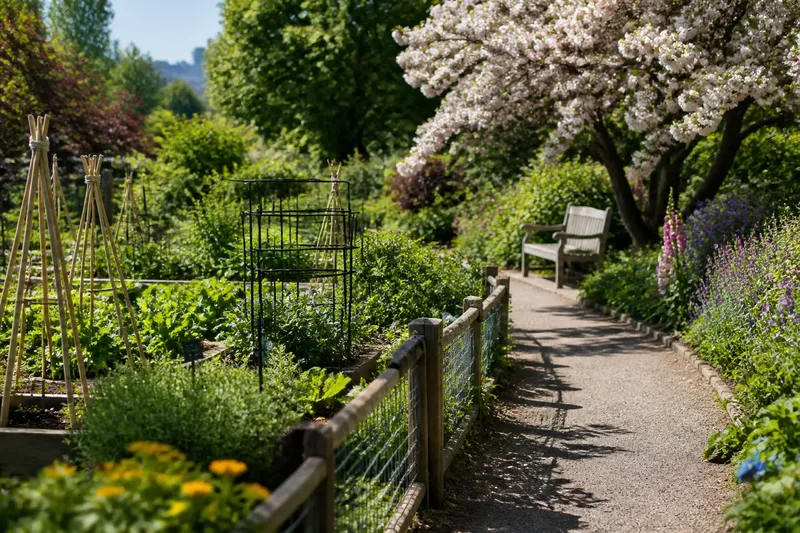
At a Seattle garden, a path may lead past neat beds of herbs before opening towards a bench beneath a flowering tree. That contrast helps explain the shift from kitchen garden to public pleasure ground: gardens once centred on useful cultivation could also be planned as places for visitors to walk, rest and enjoy the planting.
The change was not a single event, nor did it happen everywhere in the same way. Kitchen gardens, often associated with supplying a household or institution, prioritised growing and access for tending. Pleasure grounds gave greater attention to the visitor’s experience, using paths, views and places to pause. In many gardens, these purposes overlapped rather than replacing one another.
Two garden purposes
A kitchen garden is organised around producing food or herbs. Beds may be grouped for cultivation, with paths that make watering, weeding and harvesting straightforward. Its practical character does not mean it lacks beauty; a well-kept productive plot can be pleasing to look at, too.
A pleasure ground is designed, at least in part, for enjoyment by visitors. Paths may guide a walk, trees can frame a view, and a bench invites a pause. The term has been used for different kinds of landscaped grounds over time, so it is safer to treat it as a description of purpose than as a fixed layout or a claim about every garden’s history.
Public gardens can combine both ideas. A herb bed beside a path might supply useful plants and invite close attention, while fruit trees can contribute shade and seasonal interest alongside a crop. Rather than forcing a choice between “working” and “ornamental”, look at how the space accommodates each.
How the shift took shape
The broad change was from a garden planned mainly around cultivation and household provision towards landscapes that also made strolling and looking part of their purpose. It was uneven: private estates, institutional grounds and public parks had different owners, resources and visitors. A public pleasure ground did not necessarily grow directly out of a kitchen garden, and productive planting did not vanish when gardens became places to visit.
What changed most clearly was often the visitor’s role. In a plot focused on production, paths serve the work of tending and gathering. In a pleasure ground, routes can become an experience in their own right, leading visitors towards a view, a shaded seat or a sequence of planting. The same path can still allow access for gardeners, so its purpose may be shared.
Seattle’s rain, shade and varied growing conditions shape what appears in local gardens, but they do not by themselves explain a site’s history. Look for signs that suggest how a place is used today, and consult an on-site plaque or the garden’s own information if you want its documented past. Without that context, describe what you can see rather than assigning a definite historical origin.
Read the garden layout
Begin at an entrance and notice what comes into view first. A direct view across orderly beds may foreground cultivation; a winding path, framed outlook or cluster of seating may give more weight to strolling and lingering. These are clues, not proof: gardeners may need convenient routes, and a productive space can be arranged to welcome visitors.
Then look at boundaries and access. Labels, supports for climbing plants and clear working paths can point to cultivation. A bench facing a border or a path that curves through planting suggests attention to visitors’ comfort and experience. A low fence may protect delicate beds while still allowing people to look closely.
Say you enter a neighbourhood garden where labelled vegetable beds sit behind a low boundary, with a flower border and bench beside the path. First, you note the labels and supports as evidence of active cultivation. Next, you follow the public path and see that the bench faces the beds rather than turning away from them. Your resulting reading is that the layout accommodates both growing and visiting; it does not establish whether the garden began as a kitchen garden or was later converted.
Clues to check
- Bed arrangement: If rows and narrow access paths make the beds easy to tend, record cultivation as a visible purpose; if beds are grouped mainly for viewing from a path, note visitor display instead, while allowing for overlap.
- Plant labels: If labels identify herbs, vegetables or fruit, treat them as evidence of intended use; if there are no labels, describe the plants you recognise without assuming the rest are ornamental.
- Supports and structures: If you see trellises, stakes or fruit-tree guards, note how they help plants grow; if a structure’s purpose is unclear, leave it open rather than assigning a function.
- Path direction: If a route gives gardeners direct access between beds, record its practical role; if it curves towards a view or seating, note the visitor experience, and if it does both, record both.
- Seating and outlook: If a bench faces planting or a framed view, note that the garden offers a place to pause; if there is no seating, do not infer that visitors are unwelcome, since paths and views may still serve them.
- Visitor guidance: If signs ask visitors to stay on paths or avoid harvesting, follow those instructions; if guidance is absent, keep to established routes and do not treat access as permission to pick plants.
Questions about garden history?
Did pleasure grounds replace kitchen gardens?
Not as a universal pattern. Some grounds combined productive and ornamental planting, while others were designed for different uses from the outset; a site’s specific history needs evidence from its own records or interpretation.
What makes a garden public?
Public access is a matter of permission and management, not simply appearance. Check the site’s signs or official information before assuming that a garden is open to visitors or that every area can be entered.
Can a productive garden also be ornamental?
Yes. Flowers can border food beds, and useful plants can be arranged for visual interest as well as harvest. The presence of attractive planting does not erase a practical purpose.
How can I check a garden’s past?
Start with plaques, interpretation boards and information published by the site or its managing organisation. If those sources do not establish a connection to a kitchen garden or pleasure ground, keep your description to the visible layout and uses.
Record what you see
After a visit, write two brief observations: one about cultivation and one about the visitor’s route or places to pause. For instance, “labelled herb beds beside a straight service path; bench faces the border” captures evidence without claiming more history than the setting provides.
On your next walk, search for Seattle’s kitchen gardens and public pleasure grounds as overlapping ideas rather than tidy stages in a universal story. The most useful distinction is often visible in the arrangement: what helps plants grow, what invites people to stay, and where one feature does both.